How to open your own squash court? An investor’s guide
2025-08-21
How much does a squash court cost? Construction and installation
Recently, squash has gained momentum in our country: the number of players, leagues, and events is growing, and a well-designed court quickly fills up. Such an investment is a technical and organizational undertaking, but also a great way to combine sport with community-based business. In our article, you will find a coherent plan – from understanding the market and analyzing the competition, through design, construction, formalities, and obtaining permits, to opening, marketing, maintaining, and developing the club in the future. You can rely on the support of SQUASHTECH – a manufacturer and contractor of courts that comply with WSF standards – at every stage.

Why can squash court prices vary?
The price is not a single number. The final budget is influenced by the type of court, the technologies used, the completeness of the infrastructure, and the preparation of the installation site. In 2025, investors in Poland most often choose one of the following solutions:
- standard court for clubs
- premium court for more prestigious and
- professional facilities
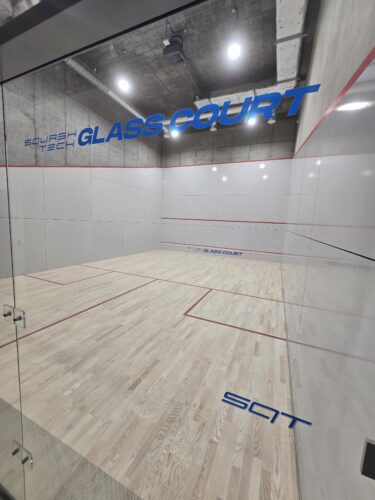
- glass court for spectators and tournaments
- hybrid or outdoor court
Each of these squash court options differs in price and construction requirements.

What exactly makes up the price of a court?
The price of building a squash court will include elements such as the type of construction, materials, installations, and the amount of work required for the project.
Type of construction and wall system
The type of construction has a direct impact on the price. We present the types of courts and wall systems, which differ in terms of purpose, parameters, and cost range.
- Standard courts – a solution resistant to intensive use in clubs and recreation centers.
- Premium courts – a system made of top-class materials with greater material resistance.
- Glass courts – structures with glass walls, welcome at tournaments and in show facilities.
- Hybrid courts – configurations combining different technologies within a single project.
- Outdoor courts – an additional outdoor attraction at the facility.
- Interactive courts – multimedia and projection accessories that enhance the gaming experience.
- Rainbow courts – dedicated to children.
- 24-hour courts – adapted for continuous use, with appropriate lighting and ventilation.
The choice of type determines the cost of materials, installation, and subsequent service.
Materials and proprietary technologies
Court equipment primarily includes:
- Wall panels
- Sports floor
- Court fittings
- Tempered glass
- Tin sheet metal
- Tapes and lines
- Safety nets
- Sound-absorbing ceiling
- Lighting
SQUASHTECH manufactures certified components for complete courts. A set of materials from a qualified manufacturer reduces the risk of incompatibility between installations and facilitates servicing.
Space preparation and installations
The installation site affects the cost no less than the court itself. The following factors are important:
- dimensions (the required installation space is approx. 10.0 × 6.70 × 5.64 m)
- the condition of the ground and the possibility of laying a flooring system
- ventilation and air conditioning adapted to the load
- lighting with sports parameters
- availability of connections and logistics at the construction stage
- the type of facility and individual requirements of investors
Personalization and facilities
Additional rooms and technologies increase the overall cost, but are no less important than the courts themselves:
- reception
- changing rooms and bathrooms
- rest areas and waiting rooms
- grandstands and spectator seating
- integration with the booking system and game accessories
Service and maintenance costs
The total cost is influenced not only by the construction and installation of squash courts, but also by their subsequent use and technical maintenance. In the case of facilities with high occupancy rates, service and the possibility of relocation are of great importance. The operating costs are calculated differently for indoor courts than for outdoor courts, which are exposed to changing weather conditions. It is worth taking into account the costs of maintenance and possible repairs.
Sample cost estimate for a squash court (2025)
The following scenarios organize the discussion about costs. Each project receives an individual quote, and the scope determines the final price.
|
Scenario |
Main assumptions |
Reference budget |
Objective |
|---|---|---|---|
|
standard club court |
• 1 standard court |
from PLN 150,000 net per court |
quick launch of a squash club at optimal cost |
|
premium court with high durability |
• reinforced floor and wall panels |
significantly above the basic threshold |
minimization of service breaks and high playing comfort |
|
Glass court for events |
• Glazed walls and exhibition character of the facility |
significantly higher than the standard variant |
visual appeal and high prestige of the facility |
|
multi-court hall |
• several courts |
multiplier depending on the number of courts; unit cost more favorable than for a single unit |
scale and high occupancy |
Dimensions and technical requirements that affect the price
Precise space parameters are essential for investment planning. It is the dimensions and technical requirements that determine whether the construction will proceed according to plan and what the final cost of the project will be.
The most important parameters to consider when building a squash court are:
- Court dimensions – 9.75 m × 6.40 m × 5.64 m
- Installation dimensions – approximately 10.0 m × 6.70 m × 5.64 m
- Typical project completion time – 6-8 weeks from contract finalization and project approval – faster construction is possible in case of special needs
Any deviations from the above conditions may increase construction costs, especially when adaptation work or structural reinforcement is required.
WSF certification and its impact on the budget
SQUASHTECH operates under the patronage of the World Squash Federation and uses solutions that comply with strict standards. Certification covers walls, floors, glass, TIN, and lighting. Choosing components with full certification increases the value of the investment in terms of long-term use and game safety.
When is it worth choosing a glass or interactive court?
There are different types of courts. A glass court improves visibility, builds image, and increases the attractiveness of events. An interactive court adds a training and entertainment layer. Both options increase the budget, but support revenue from tournaments, sponsors, and club marketing. In facilities open to the public or in shopping centers, these options definitely make sense.
Squash club from design to implementation
SQUASHTECH manages the investment from concept, through support in preparing documents, comprehensive construction, to service and assistance in running the club. What does the construction of a squash court look like – step by step?
- Contact and consultation – defining needs and budget.
- Location analysis – assessment of the facility and installation.
- Design – preparation of specifications and pricing.
- Contract and schedule – formal start of work.
- Construction and assembly – on-site implementation.
- Quality control and acceptance – verification of compliance with standards.
- Service and support – post-construction care and operational consulting.
Feel free to contact our specialists!
Where is it profitable to build a squash court?
In 2025, courts are being built in many types of facilities: fitness clubs, shopping centers, swimming pools, hotels, academic centers, amusement parks, and public investments. For municipal and provincial authorities, what matters is access to a variety of sports and the activation of residents. For hotels and resorts, what matters is the attractiveness of the offer. For club chains – turnover and profit.
Is building one court always enough?
Not always. In cities with high demand, a single court quickly fills up, which reduces availability. A hall with two or three courts increases revenue, and the unit cost per court usually decreases thanks to shared installations and assembly logistics. In selected locations, this approach allows for better balancing of expenses.
How long does implementation take and how should financing be planned?
The optimal time is 6-8 weeks from the finalization of the contract. In practice, commercial facilities plan financing in a mixed model: own funds, investment credit, leasing of accompanying equipment, and in some cases, installation with public funds. Additional sources, such as civic projects, appear in large cities and help finance part of the facilities.
What questions are worth asking?
- What is the expected occupancy of the facility (number of customers)?
- Will the plan include events with an audience and broadcast?
- Does the facility have any restrictions or special requirements?
For a recreational club with moderate traffic, a standard facility with good lighting and a solid sound system is usually sufficient. For a tournament facility, a premium or glass court would be better. For an investor with an unusual space, a hybrid option with individual modifications is a reasonable choice.
Summary of court construction costs in 2025
It is worth organizing the basic costs of court construction to better understand how the final construction cost is determined. The price is influenced not only by materials and technologies, but also by design decisions that determine the durability of the court and its comfortable use for years to come.
- Market entry threshold – from PLN 150,000 net per court in the basic standard.
- Further price ranges – depending on the type, materials, installation, customization, and location of the court.
- Deadlines – usually 6–8 weeks from the contract and advance payment.
- Standard – WSF-certified solutions increase reliability and safety.
The total budget is also affected by the costs associated with court equipment and regular cleaning, as these elements maintain the durability of the court and stabilize the final construction cost for the entire project.
Frequently asked questions
Can the court be dismantled and moved?
Yes. The panel construction allows for relocation. The operation requires an experienced team and should be planned in advance.
What are the minimum room dimensions?
Playing area: 9.75 × 6.40 × 5.64 m. Approximately 10.0 × 6.70 × 5.64 m is required for installation. Height is critical — too low a volume makes installation difficult and reduces playing comfort.
What is the process from inquiry to launch?
In order: consultation, location analysis, design and pricing, contract and schedule, installation, technical acceptance, service. This order makes it easier to stay on schedule and within budget.
Does SQUASHTECH build other racket sports facilities?
Yes. The offer includes courts for padel, racquetball, ricochet, and cubeball. The specifications are developed in accordance with the standards of the relevant federations.
Summary – how much does it cost to build squash courts?
An investor planning to build a club court in Poland in 2025 should assume a budget of PLN 150,000 net. Projects with a higher standard, glass, interactive, and extensive facilities will increase the cost of a squash court.
Contact us for a quote and professional advice!